The Challenges of Off-Grid Solar Architecture in Mpumalanga:
A Lowveld Case Study
Executive Summary: Designing an off-grid home in the Lowveld requires more than just mounting solar panels on a roof. At Eco Fusion Architecture, based in Mbombela (Nelspruit), our first-hand experience with off-grid living has revealed that the unique climate of Mpumalanga—from clear but short winter days to misty, storm-heavy summers—demands hyper-local architectural planning. This case study explores the true weather data of the region and how sustainable architecture must adapt to battery constraints, seasonal shifts, and rapidly evolving technology to create a truly resilient off-grid home.
1. The Off-Grid Dream vs. The Mpumalanga Reality
Many homeowners in the Lowveld, Swaziland, and Mozambique approach us with a clear goal: complete energy independence. The dream is to sever ties with the grid and rely entirely on the abundant South African sun.
However, having personally lived through the transition to an off-grid system, I learned that the reality is often much more complex. Early on, I experienced the frustration of having the wrong system installed. I found myself constantly adapting my daily life to fit within the system's strict constraints, rather than having a system that supported my lifestyle.
Furthermore, I had to navigate the harsh reality of technological obsolescence. Older systems, particularly those relying on traditional lead-acid batteries, have shockingly short lifespans and are severely impacted by our local temperature fluctuations. These personal challenges fundamentally shifted how Eco Fusion Architecture approaches sustainable, off-grid design.
2. The Winter Solar Paradox: Clear Skies, Lower Yield
One of the most persistent myths about solar power in Mpumalanga is that our cloudless winters provide the best energy generation. Intuitively, it makes sense.
The Weather Data (June & July):
Cloud Cover: Skies are clear or mostly clear 91% of the time.
Rainfall: Averaging just 0.2 inches over 0.9 rainy days per month.
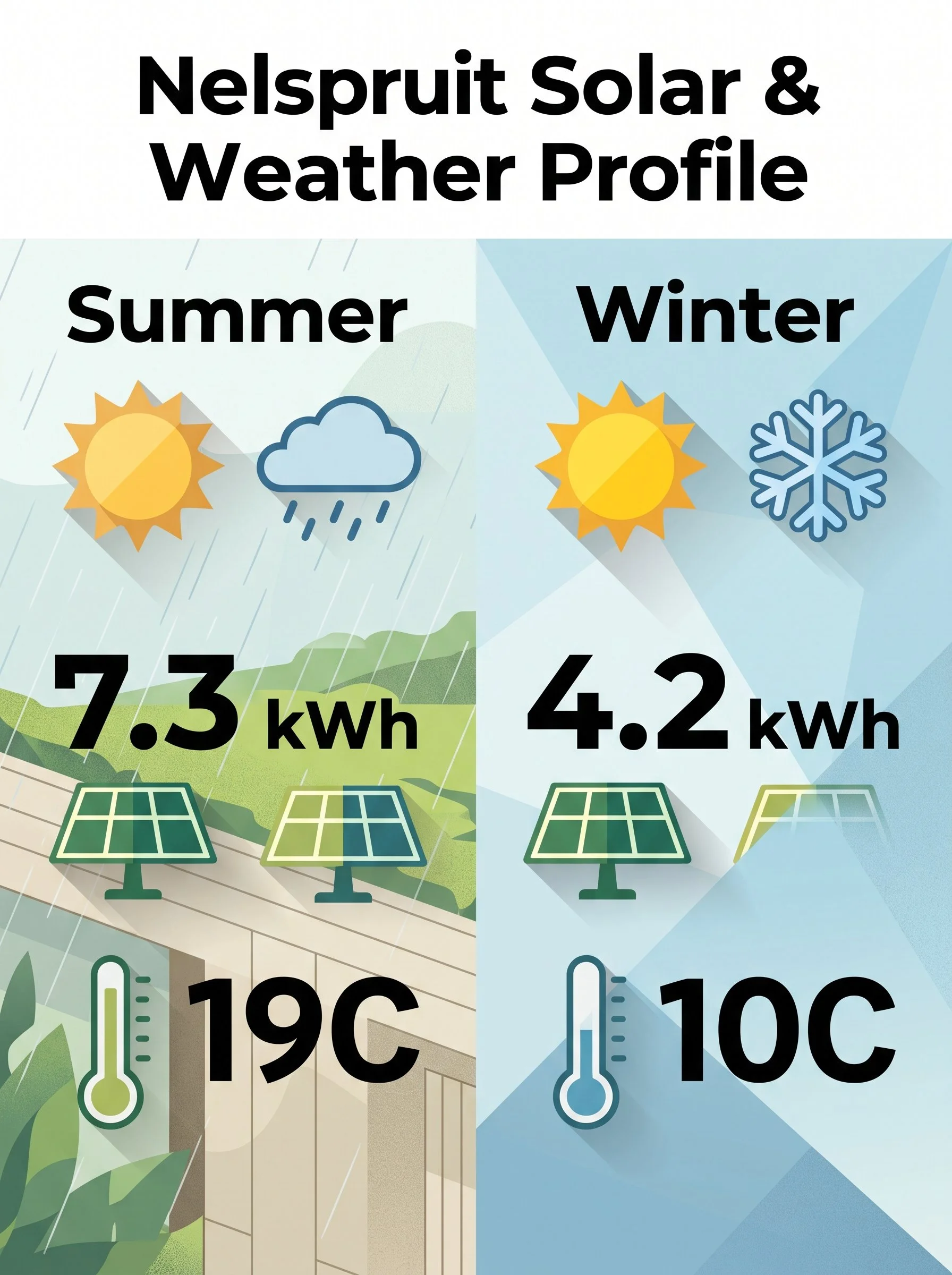
The Architectural Challenge: Despite the beautiful, uninterrupted sunshine, winter actually presents the greatest risk of power failure. Because the days are significantly shorter (only 9-10 hours of daylight) and the sun sits much lower in the northern sky, the average daily incident shortwave solar energy drops drastically to just 4.2 kWh.
This means winter generation is highly predictable, but the overall yield is low. If a home's roof pitch and panel orientation are not architecturally optimized for the low winter sun, or if the system is not deliberately oversized to account for shorter days, the home will run out of power—even on a perfectly cloudless July afternoon.
3. The Summer Scramble: Peak Power Met With Unpredictability
Summer in Nelspruit brings the exact opposite set of challenges.
The Weather Data (January):
Solar Energy: Peak generation capacity jumps to 7.3 kWh per day.
Cloud Cover: Clear skies drop to 63%, with heavy overcast conditions common.
Rainfall: High precipitation averaging 4.6 inches across 14.5 rainy days.
The Architectural Challenge: While summer offers massive energy potential, it is highly erratic. The muggy Lowveld mornings often begin with heavy mist that blocks early solar generation, followed by intense, dark afternoon thunderstorms.
Architecturally, this means a home cannot rely on a steady trickle of power throughout the day. The system must be designed to rapidly harvest energy during the short windows of intense midday sun and store it efficiently to buffer against multi-day storm fronts.
4. The Battery Bottleneck: Cold Nights and Obsolete Tech
The heart of any off-grid home is not the solar panel; it is the battery. And batteries are highly sensitive to the Lowveld's climate.
During peak winter, nighttime temperatures in Nelspruit can drop to 50°F (10°C) or lower in surrounding elevated estates like Shandon. For older technologies like lead-acid batteries, this cold is devastating. Cold temperatures increase internal resistance, restricting charging rates and dramatically shortening the battery's overall lifespan.
When you combine cold-weather degradation with a technology that is quickly becoming unserviceable and obsolete, homeowners are often left replacing expensive battery banks every few years.
5. The Eco Fusion Architecture Solution
You cannot solve climate challenges simply by throwing more panels at the problem. A truly sustainable off-grid home must integrate energy generation into the fabric of the building itself.
Here is how Eco Fusion Architecture mitigates these regional challenges:
Passive Solar Design: We orient the home and calculate roof overhangs to maximize winter sun penetration for natural heating, while blocking the harsh summer sun to reduce the energy load required for air conditioning.
System Sizing for the "Worst-Case" Season: We design our energy models based on the 4.2 kWh winter lows, not the 7.3 kWh summer highs, ensuring consistent year-round power.
Battery Climate Control: We architecturally integrate utility and battery rooms into the thermal envelope of the house. By keeping modern battery systems insulated from the 10°C winter nights and the 30°C+ summer days, we protect the technology and extend its lifespan.
Future-Proofing: We design electrical infrastructure to accommodate future technological upgrades, moving away from short-lived lead-acid tech toward modular, serviceable modern chemistries.
About Eco Fusion Architecture Established in 2009, Eco Fusion Architecture is a sustainable architecture and project management firm headquartered in Mbombela (Nelspruit), serving the wider Lowveld region, Swaziland, and Mozambique. We specialize in meticulously detailed, eco-friendly designs for residential estates and commercial developments, harmonizing client aspirations with environmental responsibility. Our team integrates advanced digital modeling from conceptual sketches through construction administration to mitigate risks and optimize resources.
Are you planning a sustainable build or an off-grid transition in the Lowveld? [Contact our studio today] to ensure your design is optimized for our unique climate.